The Importance of Digital Marketing for Your Business Success


Businesses must adapt to the rapidly changing digital environment to remain competitive and efficiently engage their target audience. Digital marketing has emerged as a game-changer, providing a diverse set of methods and platforms for connecting with clients, driving growth, and achieving measurable outcomes.
With the decline in the effectiveness of traditional marketing and the global increase in internet users, digital marketing has become a vital tool for organizations of all kinds. Companies that use online platforms such as social media, search engines, and email can reach large numbers of potential customers, target specific demographics, and deliver personalized messaging that resonates with their audience.
In the following sections, we will look at how businesses may use digital marketing to level the playing field, the importance of digital marketing, how to interact with their internet-based client base, how to measure success, and how to build a strong brand identity.
What Is Digital Marketing and its Importance
Digital marketing is the use of online platforms, technologies, and tactics to promote products or services. It connects organizations with their target audiences via the internet and digital devices, offering a more personalized, measurable approach than traditional marketing.
However, how does digital marketing work? From social media and search engines to email and mobile apps, digital marketing enables firms to contact their target audience at every stage of the buying process. It is a critical component of modern corporate growth, enabling organizations to raise brand awareness, drive traffic, and achieve measurable results.
Importance of Digital Marketing
As you explore ways to market your business, you may encounter misconceptions about digital marketing, such as the idea that it is unimportant. But it is not true. Digital marketing is a powerful tool for growing your brand and establishing an authoritative online presence.
In fact, about half of all marketers believe that search engine optimization (SEO), a particularly effective digital marketing method, provides a higher return on investment (ROI) than any other marketing strategy. Additionally, strategies such as pay-per-click (PPC) advertising can enhance brand awareness by up to 80%.
Digital marketing can be a game-changer for firms, with the following being the benefits:
- Cost-effectiveness: Digital marketing allows you to contact thousands of potential clients at a fraction of the expense of traditional advertising tactics. You receive more bang for your buck, helping smaller firms to compete on an equal footing.
- Global reach: One of the most significant advantages of internet marketing is its lack of regional restrictions. This opens new markets and creates growth prospects that were previously unthinkable through your company’s social media accounts.
- Targeted marketing: These targeted solutions allow firms to target specific audiences based on criteria such as age, interests, and online behavior. It’s similar to having a discussion with your ideal customer, making your message more relevant and effective.
- Measurable results: Digital marketing allows you to track everything, from how many people view your ad to how many click on it. This data lets you observe what is and isn’t working in real time, so you can fine-tune your plan for better outcomes.
- Flexibility and adaptability: Whether it’s changing ad creative, targeting different audience demographics, or experimenting with new media, digital marketing allows firms to remain nimble and sensitive to change, assuring long-term success and brand expansion.
- Enhanced client interaction: Digital marketing facilitates direct communication between organizations and their target customers. You may communicate with customers in real time using social media, email, or live chat, creating trust and loyalty along the way.
Why Modern Businesses Cannot Ignore Digital Marketing?
Marketing is essential, and digital marketing demonstrates this clearly. It provides targeted audience engagement, low-cost ways, and satisfactory results. As a result, the company can adapt to the market and respond quickly to changes in consumer needs, which is essential to remaining competitive in the ever-changing world of digital commerce.
So, why do businesses need digital marketing? Digital marketing has grown increasingly important in today’s quickly changing business climate, where consumer behavior and technology are reshaping how businesses interact with their audiences. Recent global events have expedited the digital transition, making online presence not only an advantage but also a critical requirement for corporate survival and growth. Companies that use digital marketing tactics are better positioned to respond to changing market conditions and reach customers where they spend the majority of their time: online.
Role of Digital Marketing in Business
There are several fundamental reasons why digital marketing is so important in today’s corporate world. First, the tremendous shift in consumer behavior to online channels has made digital presence critical for reaching and engaging potential customers. Second, the growing sophistication of digital tools and platforms allows businesses to create more personalized and successful marketing efforts. Third, the capacity to monitor and optimize marketing initiatives in real time opens previously untapped opportunities to increase ROI and business outcomes.
Furthermore, the democratization of digital marketing tools has created a level playing field, allowing firms of all sizes to compete effectively in their particular marketplaces. Digital marketing business strategy campaigns enable small firms to reach global audiences with targeted messaging and compete with larger organizations. This accessibility has changed the way organizations approach market expansion and consumer acquisition.
Key Benefits that Businesses Gain from Digital Marketing
The benefits of digital marketing include market size, effectiveness of digital marketing tactics, and increased brand visibility. It provides effective methods of boosting the consumer base, allowing the company to expand its market.
Advantages of digital marketing
To gain a better understanding of these benefits, let’s look at some practical examples.
- Online marketing enables organizations to more effectively target local clients based on their geographical location. Local SEO assists small companies by providing tailored adverts that can inspire consumers to visit shops, increase sales for brick-and-mortar retailers, and strengthen community ties.
- Digital marketing offers options for promoting relevant landing pages, content, and messages. Companies are better able to navigate potential clients and turn them into customers.
- Social media and content marketing can increase brand awareness and legitimacy. Being always present, in one’s pocket or hand, continuously supplying for their needs, or simply entertaining them ensures that businesses have their customers’ loyalty.
- Reviews, testimonials, and ongoing communication all contribute to increased confidence in digital marketing. Providing exceptional consumer connection and openly exchanging information in the digital arena ensures corporate viability.
How Digital Marketing Works for Businesses
Digital marketing refers to the promotion of companies, services, or products online using devices such as mobile phones, laptops, and tablets. It covers methods such as content marketing, SEO, social media marketing, and influencer marketing, all of which try to attract online audiences.
Digital marketing improves customer engagement and retention by targeting consumers with relevant content. Ordinary communication in this industry fosters stronger connections, increases consumer loyalty, and expands commercial opportunities. Any company, no matter how small, has a good chance of occupying its proper place on the Internet if it employs innovative strategies and launches specific promotions.
The cost-effectiveness and worldwide reach of digital marketing have fueled the transition away from traditional tactics. Digital marketing enables firms to communicate with customers worldwide through platforms such as social media, search engines, and email. Unlike traditional marketing, digital marketing provides focused, tailored communications that increase campaign effectiveness.
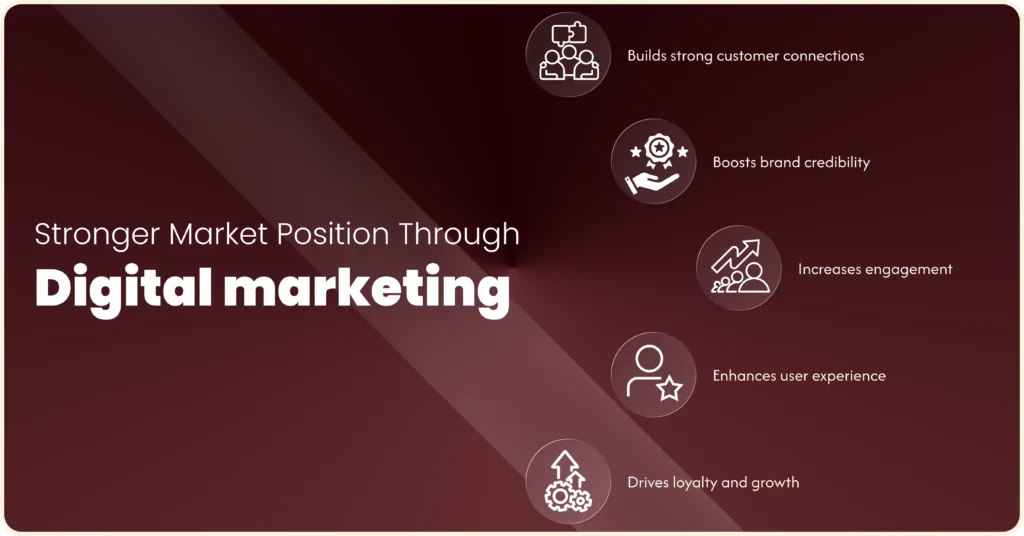
How Digital Marketing Strengthens Your Market Position
Digital marketing offers a variety of tactics for developing strong client interactions and establishing a reputable brand. Businesses can address customer pain issues and communicate directly with their audience by creating content such as podcasts, webinars, and chatbots. Chatbots, for example, enhance the user experience by assisting visitors who may leave without making a purchase, assuring ongoing engagement.A strong brand reputation is critical for long-term success. Businesses may establish trust and loyalty in the market by providing value and communicating transparently. Highlighting the advantages of digital marketing, it is critical in strengthening these relationships and increasing brand reputation, allowing firms to thrive and grow in a competitive climate.
Proven Digital Marketing Strategy
Another advantage of digital marketing is the wide range of solutions available. There are numerous ways to market to individuals online, each with its own benefits. You may focus on developing website content to improve your search engine rankings, or you could send out emails. You might even market to folks via social media.
Let’s take a look at some of the most effective digital marketing strategies for increasing internet presence and generating leads.
- Search engine optimization (SEO)—It is the process of improving your website and content to increase your exposure in search results, allowing you to reach individuals who are looking for your products or services.
- Pay-per-click (PPC) advertising—This involves placing sponsored adverts in search results or on social media, and you only pay when someone clicks, allowing you to drive speedy, targeted traffic.
- AI search optimization—This technique optimizes your content and website to appear in AI-powered search experiences and answer engines, assuring your visibility as search evolves.
- Social media marketing—It entails increasing brand exposure and engagement with your target audience on platforms such as Facebook, Instagram, LinkedIn, and TikTok via organic postings and paid advertisements.
- Email marketing– This initiative entails sending targeted emails to subscribers in order to stay engaged and stimulate repeat purchases.
- Content marketing—Creating informative material, such as blog entries, videos, and guides, that addresses your audience’s queries and encourages them to make a purchase is the main goal of content marketing.
Digital Marketing for B2B Business Growth
B2B digital marketing has evolved tremendously in recent years, with data and personalization taking center stage. Marketing leaders are now under increased pressure to generate measurable outcomes while also developing true connections with their target accounts. The most successful B2B businesses have abandoned traditional marketing tactics in favor of integrated strategies that include content, social media, email, and targeted lead creation. In 2018, Google reported that 67% of purchases in the pack-and-ship industries were impacted by digital. Surely, this figure has risen in 2024 and 2025.
Simply put, online digital marketing for B2B is the most cost-effective and efficient way to reach your target audience and increase revenue. Email marketing, video marketing, social media, and website-based advertising are just some of the countless channels available to us through digital marketing.
Finally, compared to, for example, advertising print ads or direct mail, it is far simpler to gauge the success of any digital marketing strategy. It will be simpler for us to evaluate the results, defend our marketing expenditures, and modify our techniques and strategies based on the facts. This complete, data-driven, technology-enabled approach lays the groundwork for long-term digital marketing growth.
Conclusion
Digital marketing increases sales by matching tactics with customer habits and using technology to maximize interactions. Businesses may convert potential customers into loyal buyers by using targeted, data-driven techniques and compelling content. This drives long-term revenue development. Want to explore how digital marketing may benefit your business? Contact the MediaMatic studio for a consultation tailored to your sales objectives.
Frequently Asked Questions
Is digital marketing really necessary for business success today?
Yes, digital marketing is really necessary for business today. It is important for businesses because it allows for direct engagement with the audience in real time, allowing enterprises to market themselves to a global audience. Overall, activity-based marketing approaches will increase marketers’ understanding and prediction of consumer behavior, allowing them to maximize their overall return on investment in marketing efforts while also increasing consumer pleasure
How does digital marketing make a brand noticeable in a competitive market?
Digital marketing helps a brand stand out by allowing it to reach the appropriate people rather than just more people. With the perfect combination of content, social media, and SEO, you can highlight your brand’s uniqueness, connect with your target audience, and establish trust.
What makes digital marketing more powerful than traditional marketing?
Compared to conventional marketing techniques like print, television, and radio, digital marketing can be more successful, economical, and adaptable. Additionally, it provides additional performance and customer behavior data that can guide important choices and guide future tactics.
How does digital marketing convert online interest into actual sales?
A high return on investment (ROI) is achieved through digital marketing. Businesses can get notable campaign outcomes while minimizing expenses by utilizing strategies such as social media marketing, SEO and email marketing. Real-time tracking of marketing campaign effectiveness allows you to make quick modifications and make sure your money is being spent effectively.
Can digital marketing work for both B2B and B2C companies?
Yes, companies may effectively serve both B2B and B2C audiences by customizing their marketing and messaging to each group’s particular requirements. B2C marketing is aimed directly at the consumer who will purchase your product or service. B2B marketing strategies target individuals or teams who make purchase choices for larger organizations. Both types of marketing target a different audience; thus, various tactics are required to make each one effective.
How much should a business budget for effective digital marketing?
According to the U.S. Small Business Administration’s (SBA) guidelines and other industry standards from research firms like Gartner and Deloitte, the majority of marketing experts advise dedicating 5–15% of your overall revenue to marketing.